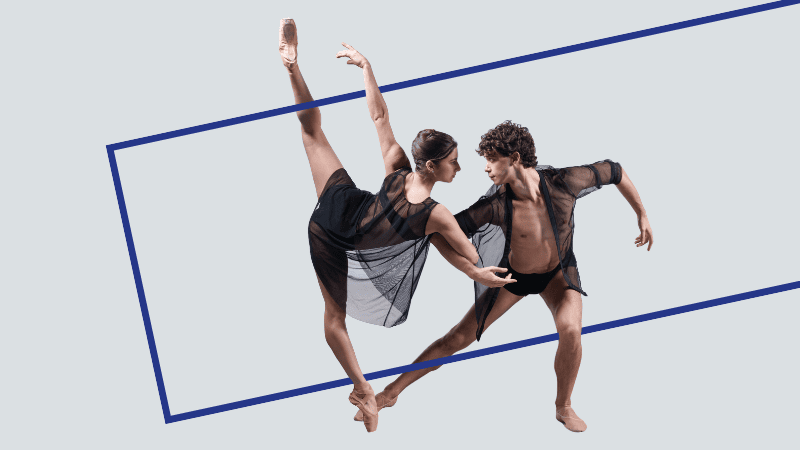
Discover French Kiss
Stabat Mater
World Premiere: May 15, 2002
Choreography: Michael Smuin
Music: Antonín Dvořák
Costume Design: Ann Beck
Lighting Design: Sara Linnie Slocum
Lighting Adaptation: Michael Oesch
Set Design: Alexander V. Nichols
Stabat Mater premiered in 2002 as Michael Smuin’s response to 9/11. The ballet explores themes of loss, the resilience of community, and, ultimately, hope. April 2027 will mark the 20th anniversary of Michael’s passing—in this moment we reflect on his enduring legacy. His death was a profound loss for our organization. Since his passing, we not only survived but thrived, thanks to our community’s unwavering support. Michael’s legacy is one of hope.
“At a memorial concert at St. Patrick’s Cathedral in New York [following 9/11], the president of the Vienna Philharmonic, speaking of art as a gift from God, said it better than I can. He said that art gives us “a sense of eternity and with it an idea for the fulfillment of our desire for peace and harmony.” When I found myself playing the Dvořák Stabat Mater over and over, I realized that I had found my response to all the death and pain of those terrible days.” – Michael Smuin
I-SCRIT-AH-SCREE-TAH-SKRATT: World Premiere
World Premiere: September 11, 2026
Choreography, Costume & Stage Design: My’Kal Stromile
Music: Wilhelm Friedemann Bach
Lighting Design: Michael Oesch
“I-SCRIT-AH-SCREE-TAH-SKRATT, an invented phonetic phrase, resembles a kind of cognitive buffering or internal recalibration—language attempting to organize itself before becoming coherent. Originally developed during a period of personal and professional transition for Stromile, the work has evolved into a broader choreographic investigation of thought as structure, process, and motion. In this expanded iteration, the foundational orientations of classical ballet function as evolving kinetic thought engines. Croisé (crossed/crossing), effacé(shaded or revealed), and écarté (divergence/separation) become dynamic organizational principles, structuring relationships between bodies, trajectories, timing, and space. Rather than fixed academic images, these orientations become generative systems producing physical reasoning, spatial consequence, counterpoint, interruption, fragmentation, accumulation, and transformation. Within this system, silence becomes a space in which thought takes shape before articulation, while music becomes a form of speaking.” – My’Kal Stromile
French Kiss
World Premiere: April 28, 2023
Choreography: Amy Seiwert
Music: Pink Martini
Lighting Design: Jim French
Costume Design: Susan Roemer
“My parents lived in Paris for a few years when I was in my 20s, and I had the good fortune of spending extended time there. The city left an imprint on me, and this piece is a love letter to that time.” – Amy Seiwert